
This section collects articles focused on the professional use of Fire Dynamics Simulator (FDS) and fire modeling concepts relevant to performance-based fire engineering.
This assumes familiarity with FDS fundamentals and covers both:
- theoretical aspects that influence modeling choices
- practical considerations arising in real engineering applications
The aim is to provide context, reasoning, and depth on topics that are often simplified or overlooked when learning FDS only as a software tool.
About the author
These articles are written by a fire safety engineer working with fire modeling and performance-based design.
My work with FDS involves:
- understanding the physical and theoretical assumptions behind the models
- translating theory into appropriate modeling strategies
- evaluating the limitations and uncertainty of simulation results
- interpreting outputs within an engineering and regulatory framework
The content in this section reflects how I approach FDS as an engineering tool grounded in theory, rather than as a black-box simulator or a set of isolated examples.
For whom this section is intended
This section is intended for fire safety engineers and technical professionals who already have experience in Fire Safety Engineering and are looking to deepen their understanding beyond basic software operation.
The articles are written from an engineering peer perspective and assume:
- familiarity with fire modeling concepts
- experience with FDS in non-trivial scenarios
- interest in the reasoning behind modeling choices, not just inputs and outputs
Some topics are more theoretical, others more application-oriented, but all are approached with the assumption that the reader is an experienced engineer engaging critically with FDS, not a beginner following predefined steps.
Article list
- FDS Mesh Sensitivity Analysis Example
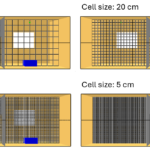 The following presents an example of mesh sensitivity analysis for an office fire scenario, aiming to evaluate how mesh resolution affects simulation results. Key Inputs: Characteristic Fire Diameter and Initial Mesh Selection Before running the simulations, the Characteristic Fire Diameter (D*) is calculated. This parameter provides a guideline for… Read more: FDS Mesh Sensitivity Analysis Example
 - Mesh Sensitivity Study in FDS: Concepts, Practice, and Interpretation
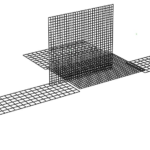 In Fire Dynamics Simulator (FDS), a mesh sensitivity study is the process used to verify that simulation results are controlled by the modeled fire physics rather than by the numerical resolution of the computational grid. This step is essential for any simulation intended to support engineering decisions, because an… Read more: Mesh Sensitivity Study in FDS: Concepts, Practice, and Interpretation
 - Heat Release Rate (HRR) Curve: A Comprehensive Guide
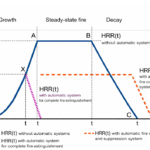 The Heat Release Rate (HRR) is the single most important variable in fire hazard analysis. It serves as the primary driver for all quantifiable fire effects, including compartment temperatures, smoke transport, and the activation of fire protection systems. This article explains how to calculate the Heat Release Rate (HRR)… Read more: Heat Release Rate (HRR) Curve: A Comprehensive Guide